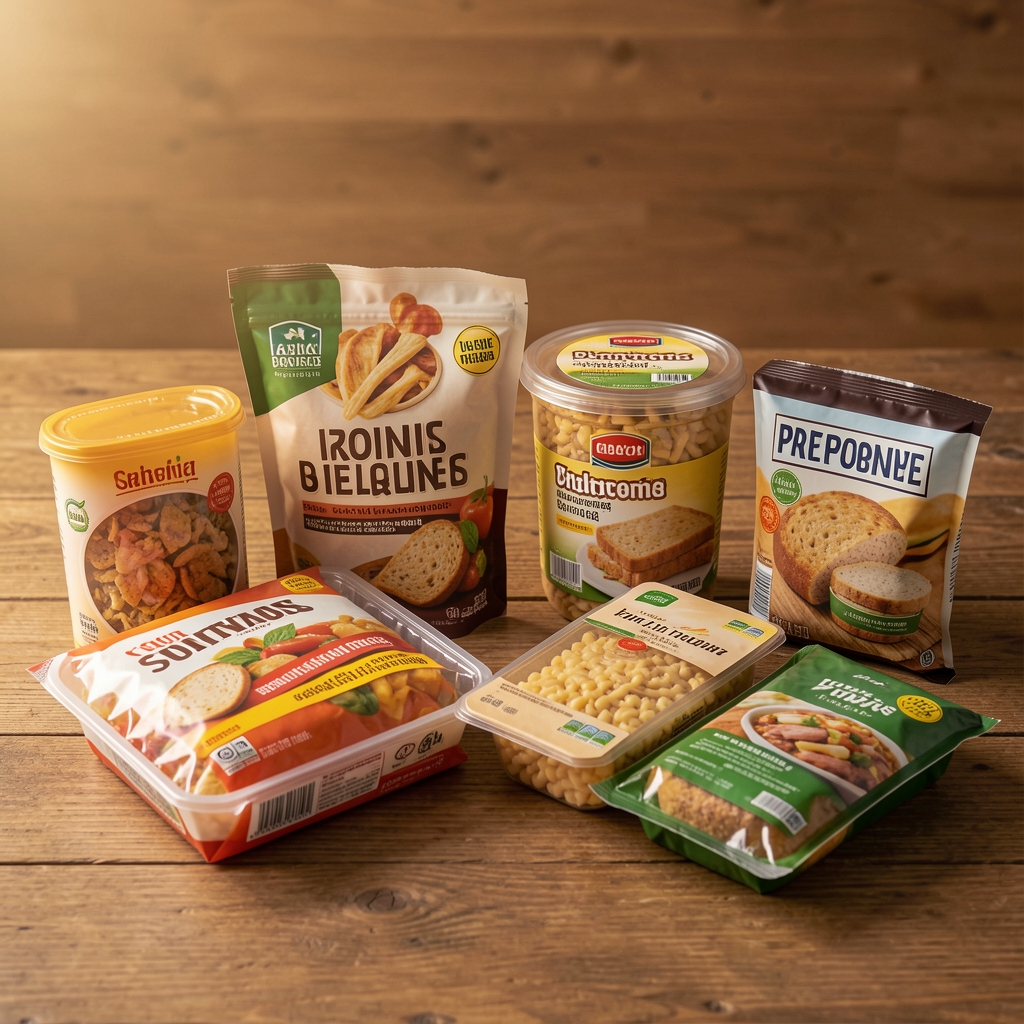
There is a particular kind of food that does not require much thought to acquire. It arrives quickly, it leaves quickly, and it rarely invites reflection about what it contained. Processed food reliance in England has grown not because people stopped caring about what they eat, but because the conditions that make cooking at home possible — time, energy, routine, and sometimes cost — have narrowed. The ready meal and the fast food order are not failures of individual will. They are responses to a specific set of pressures, and understanding those pressures is where an honest reckoning with convenience food patterns has to begin.
How Convenience Became Default
The phrase "convenience food" once carried a light stigma — the sense of something chosen for ease at the expense of quality. That moral charge has largely dissolved. In its place is a quiet normalisation: the ready meal in the supermarket chiller, the delivery app on the lock screen, the takeaway ordered on the same evening every week. Fast food frequency among adults in England has increased steadily over the past two decades, with a growing proportion of households consuming processed food as a primary rather than supplementary source of daily nutrition.
What changed was not simply the availability of processed food — that has been broadly constant since the 1980s — but the structure of daily life around it. Longer working hours, reduced lunch breaks, the erosion of domestic cooking as a shared household activity, and the expansion of food delivery infrastructure have collectively shifted the cooking-at-home calculus. The result is that convenience food patterns that were once confined to specific meal occasions (the weeknight when nothing was planned, the Saturday after a long week) have extended across the whole rhythm of the week.
Research examining household food diaries consistently shows that ready meal reliance tends to cluster in particular demographic groups: single-person households, those in shift-based employment, and younger adults living in urban areas. These are not people choosing processed food because they are unaware of cooking at home benefits. They are, more often, people for whom the practical barriers to cooking have accumulated to a tipping point.
"The ready meal is not a personal failing. It is an infrastructure outcome — the product of how time, labour, and food supply have been arranged around one another."
The Nutritional Landscape of Processed Food
Understanding the nutritional profile of heavily processed food requires looking beyond the obvious category of fast food. High-salt food habits, refined carbohydrates and weight, hidden sugars in everyday food — these concerns appear not only in takeaway meals but in the category of products sold in supermarkets as ostensibly ordinary: breakfast cereals, flavoured yogurts, pasta sauces, packaged soups, and sliced bread. The category known in nutritional research as ultra-processed food (UPF) is defined not by its preparation speed but by the degree of industrial processing it has undergone and the range of additives and flavour-enhancement agents it contains.
High-salt food habits that develop through regular processed food consumption have been documented in population-level dietary surveys in England for years. Sodium content in ready meals regularly exceeds 40 per cent of the recommended daily intake in a single serving. Refined carbohydrates and weight are closely linked in published nutritional research: diets with a high proportion of refined starch tend to produce faster energy release and shorter satiety windows, which in turn affects eating speed and fullness, portion behaviour, and the likelihood of mindless snacking between meals.
Hidden sugars in everyday food represent one of the more structurally invisible aspects of convenience food patterns. Sugar appears in products where its presence is not obvious — savoury sauces, processed meats, flavoured waters, crackers. Liquid calories awareness is a related issue: the contribution of sweetened drinks, flavoured coffees, and fruit juices to daily energy intake is consistently underestimated in self-reported dietary records. People who would readily identify an additional meal as excessive often do not register the same total from drinks and snacks consumed over the course of a day.
Restaurant Eating Frequency and the Weekend Pattern
Restaurant eating frequency has a different character from weekday processed food consumption. For many households, eating out or ordering in during the weekend operates as a deliberate indulgence — the earned relaxation after a week of more managed eating. Weekend indulgence patterns are well-documented in dietary research: the strict structures people apply to weekday eating are often suspended on Friday evenings, and the cumulative effect of weekend eating can offset several days of careful weekday choices.
This is not a moral observation. The weekend is when people have the most social latitude — meals with friends, family gatherings, the Friday night dinner that marks the end of a working week. Restaurant meals and takeaways are embedded in these social rhythms in ways that make them resistant to simple nutritional calculus. The question for anyone interested in gradual dietary improvement is not whether weekend restaurant eating should stop, but how it fits within a broader weekly food rhythm, and whether the choices made in restaurants differ substantially from those made at home.
Research on restaurant eating frequency suggests that the main nutritional consequence is not the specific meal consumed but the accumulated pattern: people who eat out three or more times per week tend to have higher total daily energy intakes, more erratic meal timing, and lower consumption of vegetables than those whose restaurant eating is occasional. The effect is partly about portion distortion — restaurant portion sizes often exceed domestic ones — and partly about the composition of dishes, which tend to be higher in salt, fat, and added sugar than home-prepared equivalents.
- Convenience food reliance is shaped primarily by structural conditions — working patterns, domestic infrastructure, time — rather than individual preference or awareness alone.
- High-salt food habits and hidden sugar consumption tend to accumulate across the whole processed food category, not only in obvious fast food items.
- Liquid calories awareness and eating speed and fullness are under-examined dimensions of convenience food patterns that have measurable effects on weight over time.
- Gradual dietary improvement in this context typically involves reducing fast food frequency gradually and expanding cooking at home benefits, rather than wholesale dietary change.
Gradual Change as a More Workable Frame
Cooking at home benefits are widely described in nutritional literature: lower sodium content, better awareness of ingredients, greater control over portion size, and — perhaps more significantly — the development of a consistent meal timing practice that supports more stable energy patterns across the day. The difficulty is that cooking at home is rarely presented in these terms by the people who do it. For most households, it is simply a matter of habit: some people cook routinely, others do not, and the transition between these two modes is slow and requires more than information about benefits.
Gradual dietary improvement research consistently finds that small, sequential changes to food habits are more durable than comprehensive dietary overhauls. The person who begins by making one meal per week from scratch, then extends that to two, then begins to use the skill developed in those meals as a foundation for a slightly wider cooking repertoire — this is a more reliable trajectory than the one who attempts a full elimination of convenience food in a single decision. The economics of the ready meal also play a role here: for many people, cooking at home only becomes genuinely cost-competitive with convenience food once a basic kitchen competence is established, which creates a barrier early in the habit-change process.
What the editorial writing collected in Felova Notebook returns to, across multiple subjects, is the importance of understanding food habits as patterns rather than as individual choices. Unhealthy eating habits explained through the lens of pattern — how they form, what maintains them, what disrupts them — tend to produce more useful observations than explanations that locate the issue in knowledge gaps or willpower. The person eating a ready meal at 8pm on a Tuesday is not, in general, unaware that the meal is processed. They are, more likely, embedded in a set of daily conditions that make the ready meal the path of least resistance, and changing that requires addressing the conditions as much as the choice.
Articles published on Felova Notebook are editorial in nature and reflect the writers' observations on everyday wellness practices. The content is not intended as professional advice, nor as guidance for the management of any specific condition. Readers with specific concerns about their daily routines are encouraged to speak with a qualified wellness professional.